
Departments
💡 Electrical Engineering Laboratories:
Electrical engineering laboratories play a vital role in the education and training of engineering students by providing practical experience that complements theoretical learning. These labs offer a hands-on environment where students can explore and apply key concepts related to electrical circuits, electronics, power systems, control systems, and instrumentation. By working with real components, instruments, and simulation tools, students gain a deeper understanding of how electrical systems function in practice. The labs help develop essential skills such as circuit design, measurement techniques, problem-solving, and troubleshooting. At TRAMIET we have different labs of electrical course like 1. Basic electrical lab 2. Electrical machine lab 3. Power electronics lab 4. EMMI lab 5. Transmission and distribution lab 6. Microprocessor lab 7. Analog and Digital lab 8. Signal processing lab 9. Linear control system lab
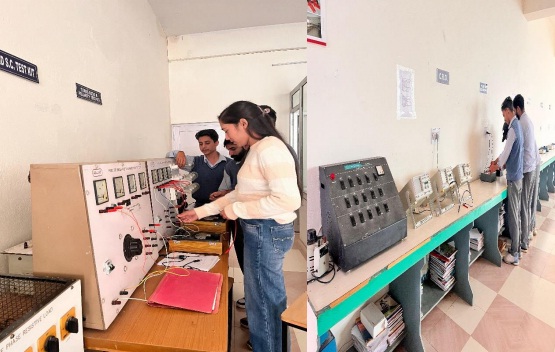
Basic electrical Engineering lab
The Basic Electrical Lab introduces students to the fundamental principles of electrical
engineering through practical experiments. It helps them understand the behaviour of
electrical circuits and components, and how to measure electrical quantities using standard
instruments. This hands-on experience reinforces theoretical concepts and builds essential
technical skills.
Objectives
To verify basic electrical laws such as Ohm’s Law and Kirchhoff’s Laws.
To measure voltage, current, and resistance using multimeters and
ammeters/voltmeters.
To study the characteristics of series and parallel circuits.
To understand the functioning of basic electrical components (resistors, capacitors,
inductors).
To learn the basic operation of electrical machines like transformers and motors.
To ensure safe practices while working with electrical equipment.
Electrical machine lab
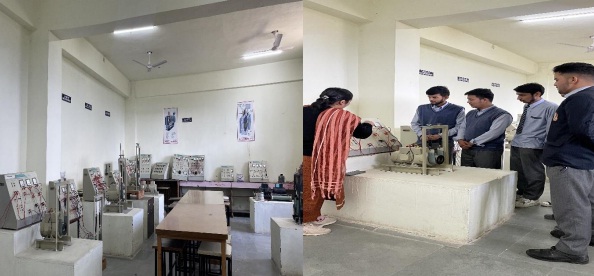
Electrical Machine Lab is a practical laboratory where students and engineers study the characteristics, operation, and performance of various electrical machines such as transformers, DC machines, and AC machines (induction motors, synchronous machines). The lab provides hands-on experience in testing, analysing, and understanding the principles of electromagnetic energy conversion. Students perform experiments to determine parameters like efficiency, torque,speed, losses, and voltage regulation. This lab is essential for bridging the gap between theoretical concepts learned in class and real-world applications in power generation, transmission, and industrial drives.
Objectives
To study the construction and working of different electrical machines.
To perform tests on DC machines, transformers, and AC machines to determine efficiency and performance.
To understand starting methods and speed control techniques of electrical machines.
To analyse the characteristics and behaviour of machines under different load conditions.
To enhance practical skills in connecting, operating, and troubleshooting electrical machines.
To promote awareness of safety procedures while handling electrical equipment.
Power electronics lab
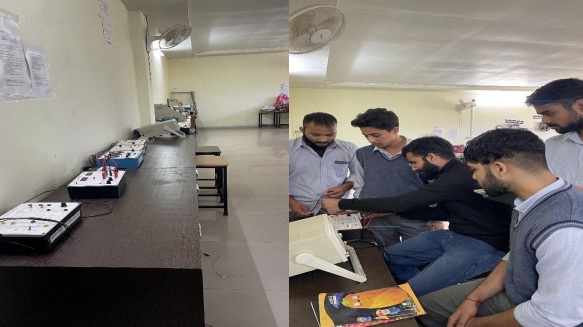
The Power Electronics Lab offers hands-on experience with power semiconductor devices
and circuits used for efficient conversion and control of electrical power. With advances in technology, the lab now utilizes modern experimental kits featuring digital interfaces, real-
time monitoring, and programmable controllers. These kits enable detailed study ofconverters, inverters, choppers, and controllers, helping students understand power electronics applications in renewable energy, electric drives, and industrial automation.
Objectives
To understand the working and characteristics of power semiconductor devices.
To design, assemble, and test different power electronic converter circuits.
To study control and triggering techniques of power electronic devices.
To measure and analyse electrical parameters and waveforms of power electronic
circuits.
To gain practical knowledge for real-world applications of power electronics
Electrical Measurement and Measuring Instruments lab
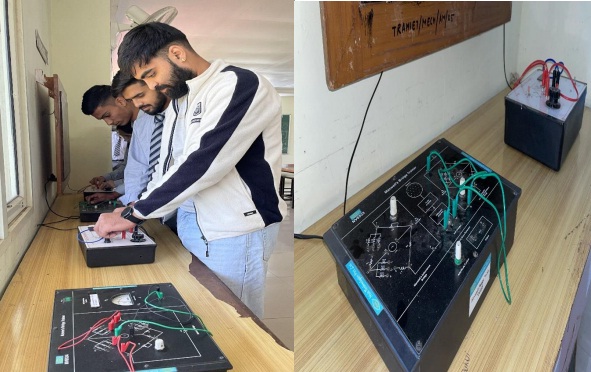
The Electrical Measurement and Measuring Instruments lab is an essential part of electrical
and electronics engineering education. It provides hands-on experience with various
instruments used to measure electrical quantities such as voltage, current, resistance, power,
energy, and frequency. The lab introduces students to both analog and digital measuring
devices and familiarizes them with their working principles, accuracy, calibration methods,
and proper usage techniques. Through experiments, students gain practical insight into the
behaviour of electrical circuits and the importance of precise measurements in engineering
applications.
Objectives
To understand the principles and operation of various electrical measuring
instruments.
To learn how to measure basic electrical quantities such as voltage, current,
resistance, power, and energy.
To study the characteristics and errors associated with different types of instruments.
To develop skills for calibrating instruments and using them effectively in practical
scenarios.
To reinforce theoretical knowledge with practical experience for better understanding
and analysis.
Transmission and Distribution (T&D) Lab
The Transmission and Distribution (T&D) Lab is designed to provide students with practical
knowledge of how electrical power is transmitted from generating stations to consumers. It
covers key components such as transmission lines, distribution systems, substations,
insulators, transformers, and protection devices. The lab simulates real-world power system
scenarios, helping students understand the behaviour of high-voltage systems, fault analysis,
load flow, and the role of different equipment in ensuring reliable and efficient power
delivery. It bridges the gap between theoretical power system concepts and practical
implementation.
Objectives
To understand the structure and operation of power transmission and distribution
systems.
To study the performance of transmission lines under various loading conditions.
To analyze the efficiency and regulation of transmission lines.
To examine different types of insulators, circuit breakers, relays, and protective
devices.
To simulate faults and study their effect on the system, including protection schemes.
To gain hands-on experience with load flow analysis and voltage regulation
techniques in distribution networks.
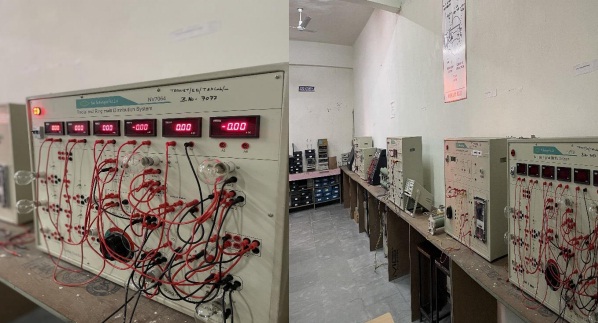
Microprocessor Lab
The Microprocessor Lab is designed to give students practical experience in programming
and interfacing microprocessors and microcontrollers. This lab typically focuses on assembly
language programming using microprocessors such as the Intel 8085 or 8086, and
microcontrollers like the 8051. Students learn the architecture, instruction sets, and how to
control external hardware through interfacing techniques. Through hands-on experiments, the
lab bridges the gap between digital electronics and computer programming, forming the
foundation for embedded systems and advanced computing applications.
Objectives
To understand the internal architecture and functioning of microprocessors (e.g.,
8085, 8086).
To develop and execute assembly language programs for various computational tasks.
To familiarize with the instruction set and addressing modes of microprocessors.
To study the concept of memory and I/O interfacing with microprocessors.
To perform hardware interfacing experiments (e.g., LED, switches, ADC/DAC,
stepper motor).
To understand timing diagrams, machine cycles, and control signals.
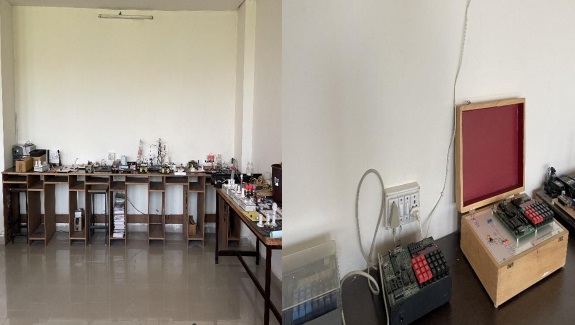
Analog and Digital Electronics Lab
The Analog and Digital Electronics Lab is designed to provide hands-on experience with the
fundamental concepts of analog and digital circuits. It bridges theoretical knowledge with
practical applications, helping students understand the behavior and functionality of various
electronic components and systems.
In the analog section, students work with circuits involving diodes, transistors, amplifiers,
and oscillators. In the digital section, they explore logic gates, multiplexers, flip-flops,
counters, and microprocessors or programmable devices.
Objectives
To understand and analyze the behavior of analog components such as diodes, BJTs,
FETs, op-amps, and their applications in amplifiers and oscillators.
To design and implement basic digital circuits using logic gates, combinational and
sequential logic elements.
To develop skills in circuit design, simulation, and troubleshooting using hardware
and software tools.
To reinforce theoretical concepts studied in analog and digital electronics through
practical experiments.
To prepare students for real-world applications in electronics, communication,
embedded systems, and related fields.
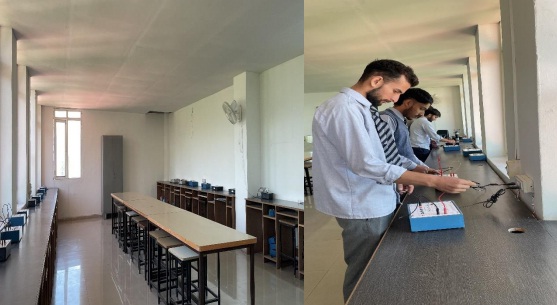
Signal Processing Lab
The Signal Processing Lab focuses on practical exposure to techniques for processing signals
such as audio, speech, images, and sensor data. Using tools like MATLAB and hardware
devices, students learn to analyse, filter, transform, and reconstruct signals for
communication, multimedia, and instrumentation applications.
Objectives
To apply theoretical signal processing concepts through practical experiments.
To learn the use of MATLAB and other tools for digital signal analysis and
processing.
To design and implement filters, modulators, and signal transformation techniques.
To gain experience in real-time signal acquisition, processing, and interpretation
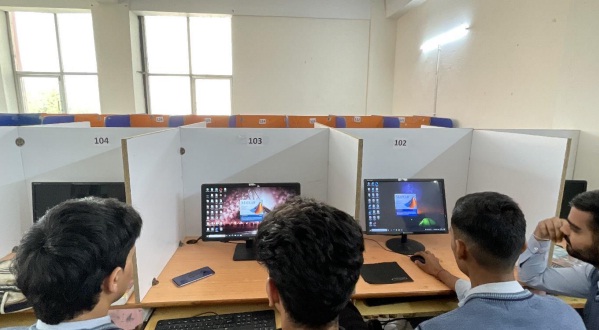
Linear Control System Lab
The Linear Control System Lab provides hands-on experience in analysing and designing
control systems that use linear models to regulate the behaviour of dynamic systems. Through
experiments with hardware setups and simulation tools like MATLAB/Simulink, students
explore fundamental control concepts such as stability, time response, and frequency
response.
Objectives
To understand the principles of linear control system analysis and design.
To study the behaviour of control systems using real-time experiments and
simulations.
To analyse system responses like transient and steady-state characteristics.
To design and implement controllers such as PID, lead, and lag compensators.
To develop skills in using instruments and software for control system testing and
validation.
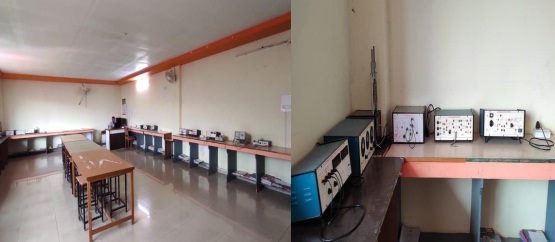
Department Gallery

Power Systems Lab

Student Project Work

Hands-on Workshop

Robotics Club Activity

Power Systems Lab

Student Project Work

Hands-on Workshop

Robotics Club Activity

Robotics Club Activity

Robotics Club Activity

Robotics Club Activity

Robotics Club Activity

Robotics Club Activity

Robotics Club Activity
(Click any image to view the full size in a new tab)